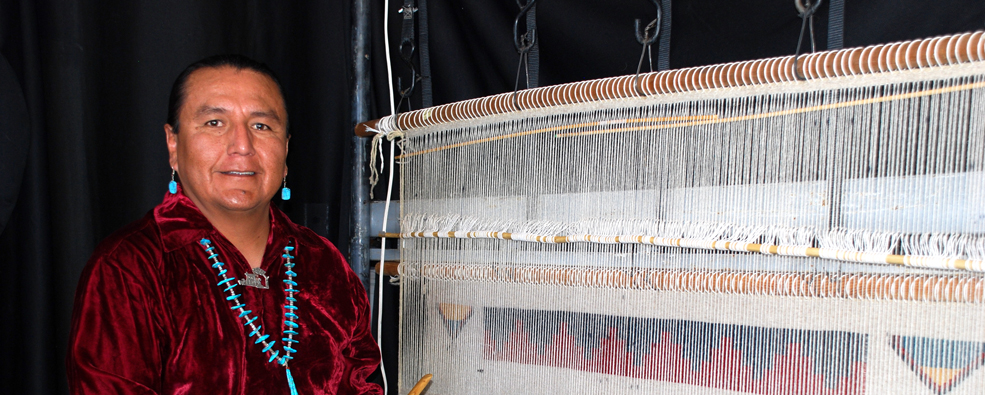
Diné weavings are highly prized weavings!
Many people have heard through the grapevine that Diné, or otherwise called Navajo, weavings were the cream of the crop. They are quick to sell at estate auctions. They’re often a shown off as a wall hanging. But what makes them so impressive?
One of the main aspects is the quality of the work. Each piece is made by a single weaver on unique loom that stands upright. There’s no machines involved to make these works of art. These looms are considered “no-loss” because they don’t have a lot of extra fringe strings at the end. There’s a lovely crafter’s post that explains how to do a more generic kind of Navajo style loom if you’d like to give them a try!
The way they’re designed, a piece can be taken off the loom at any time and reattached without issue. This is incredibly important for folks that are nomadic or with busy life-styles where you need to take the loom apart to clear the work area for other uses during the day.
But how can we look for this kind of quality in a rug that’s already done and for sale?

Warp and Weft

Let’s take a step back and go over some weaving terms so it’ll make the rest a bit easier to understand. Two terms that we’ll be using for the rest of the post are “warp” and “weft”.
The weft is the horizontal passing string. It’s the yarn that makes the design and is most visible. We can also see the weft unbroken on the side of the weavings in both Diné weavings and ones done on other styles of looms
The warp strings are the ones that vertically if you’re looking at the loom. Diné warps differ from other weaving because they are one continuous string rather than multiple strings. Other styles of looms often use multiple strings attached to a base so when the weaving is cut free, there is excess string at the top and bottom to be knotted or made into fringe. Most Diné simply have to remove the stick the warp wraps over and the weaving is ready to go.
Let’s take a look at some examples to better see how to appreciate this information!
Looking at the Warp Edges
Look at the edges of this blanket closely.
On the loom, this weaving would be made sideways. The green edge that’s on the left and right sides of the weaving, where the feet and head of the elongated figure are, would be the top and the bottom of the piece. This is also the selvage, where 2-3 extra strings are twisted while weaving through the edge strings of the piece to reinforce the borders.
This would make the green selvage strings in the close up image where the warp is. The white strings (also selvage) on the other edge is the weft.
In other weaving styles, we would expect to see tassels, knots, or otherwise some example of how the warp strings have been finished off. Instead, it is a very clean edge. If you were to pull the threads apart ever so slightly, you would be able to clearly notice the warp threads are continuous. The only tassels and extra yarn is at the corners.
Though not as obvious, you can see the same kind of style in the image of the first blanket in the post as well. The edges on the long side is the weft and the shorter top and bottom is the warp. Both have clean edges without tassels.
That’s can’t be the only significant reason we taught you about warp and weft though…right? Of course not! On to the next step!


Counting the Warp and Weft; Why it Matters


Part of the quality of any weaving is found in counting the warp and weft of the piece. We do it in daily life when we look for high count sheets! If your sheets are 300 count Egyptian cotton? Your warp might be 150 and your weft 150, so a total of 300 strings passing through a 1 inch square. There’s of course wiggle room on either side and this is just for use as an example, so let’s put it to more practical use with the same weaving we looked at previously.
First, we’re going to count the easier ones, the warp. If you’ve been following along thus far, you’ll recall they’re the vertical threads. If you look at the first image with the tape measure, we can see the feet of the elongated figure. We’ve placed the tape measure with the 2 inch starting at the base of the kilt. All we need to to is count the vertical columns within the inch. We counted 12, did you get the same?
Next, we’ll count weft and that’s only a tiny bit harder because of an extra step. Using the same area, we’re going to turn the tape measure the other direction so we can easily count the number of threads that are along one of the warps. Same measurement, starting from the 2 inch mark and ending at the 3 inch mark.
It’s normal to get a little more variance in the counting here because there can sometimes be slight differences in tension. We counted 17, but some may count and say 18. It’s okay to be off by one, and it wouldn’t be unusual to be off by one at a different location on the weaving if the tension was ever so slightly increased for a few lines.
But there’s one more step to counting weft. We double it! We do this because to weave, the strings alternate top and bottom of the warps. So for each visible string we see on the surface, there’s a twin string on the underside making the weaving double-sided. If we use our count, the true weft becomes 34!
Let’s Try Another!
We’ll use the weaving from the very first image. This time, we’ll let you use what you’ve learned so far to count warp and weft. Don’t worry, if you continue reading, we’ll give the you answers as well.
Remember…warp is easy to distinguish columns and weft is the twisted yarn that the design is woven with and gets doubled.
Which image is set to measure each one?
…
…
…
Do you have your answer?
…
…
…
Last chance before we spill the beans!
…
…
…


Let’s Get The Answer!
The warp is the second image! We can see much more defined lines in the weaving and counted 9.
The weft is the first image! The individual lines aren’t as easy to define going up. We counted a whopping 25 which puts the true weft at 50.
But How Do We Use This Information When Assessing Whether a Weaving is Diné or Not?
From Diné sources, Most Navajo rugs have approximately 30 wefts to the linear inch. A weft count of 50 per inch is a high quality rug. A count of 80 or more qualifies a rug as a tapestry. Some pieces, like the highest quality from Two Gray Hills can have a 100 weft count or MORE!
Is That All We Look For?

Unfortunately, it’s not quite that simple. Learning how to identify selvage, weft, and warp are all very important. You’re now well on your way to being more confident in Diné weaving identification! If you’re feeling daring, let’s go over a few more considerations!
Coloration: Many traditional weavers use yarn that is spun and woven without dying (with exception of some black), straight from the sheep they keep. This isn’t always true, and vegetal (made from plants) dyes are also common.
Pattern: There are books (see list at the end) to help with recognizing specific patterns that are attributed to specific Diné groups of people.
Feel of the Weaving: Quality Diné weavings have a stiffness from the tight application of the yarn. They should feel thick and a little rough as well. The yarn should be tight and no warp threads showing.
Name of Weaver: Of course, if the weaving comes with the name of who made it and tribal details, this can mean more than some of the other aspects we’ve discussed! It becomes easier to look up who that weaver is and whether they’re well known.
But None of This Information is Foolproof!
Everyone has to start somewhere, so a new Diné weaver may be using commercially dyed yarn and have a finished piece that is a bit wonky. While it’s considered a lower quality, it still is 100% a Diné weaving!
There are also incredibly skilled weavers that can create impressive pieces that may have learned from a Diné person. Someone other than an expert in the subject may be unable to tell!
Designs from Turkish weavers or even other Pueblo tribes further muddy the waters of getting a clear understanding!
But don’t be discouraged! Think of it more like an exciting adventure into more knowledge that you’ve only just begun! In the spirit of further learning….

We’d Like To Share a Recommended Reading List
While this list may look a little intimidating, you’re not expected to read the whole list and write a paper. No pressure at all. We simply wanted to share a list of respected resources to lean into if you ever wanted to dive down the winding rabbit hole (should we call it a hare hole?) of Diné textiles!
- A Guide To Navajo Rugs – Susan Lamb
- A New Deal for Navajo Weaving: Reform and Revival of Diné Textiles – by Jennifer McLerran
- Beyond the Loom: Keys to Understanding Early Southwestern Weaving – by Ann Lane Hedlund
- Color Riot! How Color Changed Navajo Textiles
- Contemporary Navajo Weaving: The Thought That Counts – by Anne Lane Hedlund
- Dances with Wool – by Mark Winter
- Horizons “Weaving Between the Lines with Diné Textiles” – Edited by Hadley Welch Jensen
- How to Weave a Navajo Rug and Other Lessons from Spider Woman – by Barbara Teller Ornelas & Lynda Teller Pete
- Navajo Pictorial Weaving – by Tyrone D Campbell & Steven Begner
- Navajo Rugs: How to Find, Evaluate, Buy, & Care for Them – by Don Dedera
- Navajo Textiles: The William Randolph Hearst Collection – by Nancy J. Blomberg
- Navajo Weaving: Three Centuries of Change – by Kate Peck Kent
- One Hundred Years of Navajo Rugs – by Marian E. Rodee
- Reflections of the Weaver’s World: The Gloria F. Ross Collection of Contemporary Navajo Weaving – by Ann Lane Hedlund
- Rugs & Posts: Story of Navajo Weaving and Indian Trading – by H. L. James
- Spider Woman’s Children: Navajo Weavers of Today – by Lynda Teller Pete and Barbara Teller Ornelas
- Swept Under the Rug: A Hidden History of Navajo Rugs – by Kathy M’Closkey
- Woven by the Grandmothers: Nineteenth-Century Navajo Textiles – by Eulalie H. Bonar
Want to see more content like this?
Subscribe below and have our updates come directly to your inbox!