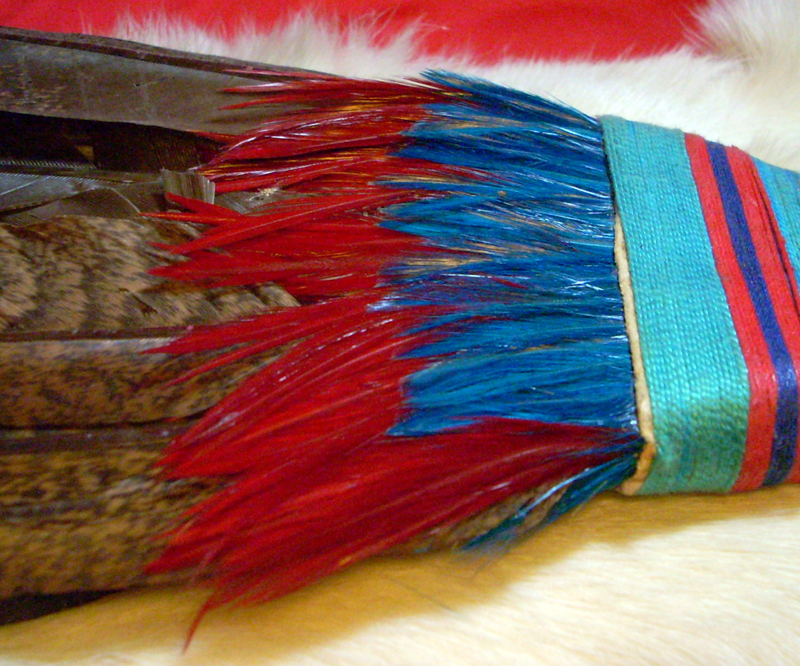
Today is the Universal Day of Culture, and a perfect day to discuss a part of culture that we often hear discussed amongst visitors. One of the items in the museum is a fan that has been labeled a Peyote Drop Fan. In western culture, psychoactive plants are often abused for recreation and enjoyment. So why do we hear about Peyote Stitch in beadwork and have a Peyote Drop Fan in the exhibits?
First, what is peyote?
Any information here is for educational purposes only and not to encourage use, identification, or harvesting. Ceremonies surrounding peyote are a closed practice, so we will also refrain from elaborating on details that are outside of available public knowledge.
It’s a small, spineless cactus by the scientific name Lophophora williamsii. While it is know for its psychoactive properties, it is also very slow to grow to maturity. Because of the poaching for recreational use, the naturally occurring population has diminished significantly.
These cactus flower and produce edible fruits, but they need very specific conditions to reach this point.
The cactus contains a variety of phenethylamine alkaloids with the most notable being mescaline. These are what is responsible for the psychoactive properties.

Native use of peyote wasn’t for fun…

the plant was seen as spiritually significant and to be highly respected. Across much of indigenous culture, spirituality is not disconnected from every day life. This would also mean that harvesting and utilizing peyote was as much a physical task and experience as much as it was spiritual.
The psychoactive reaction was considered directly connected to divine spirit. With such a status, it would have been extremely taboo to take the plant simply for recreation. To use the plant without explicit direction and purpose was near unthinkable! Many nations consider plants people just as animals are considered our cousins. They deserve as much consideration and respect as our direct family members.
The ceremonies themselves are also not just “fun trips” either. Those leading the ceremonies (like the ones that would be using the feather fan pictured here) would not partake in order to monitor the health of participants. Leaders of ceremony are trained in prayers and songs that are used; but they are there to guide participants if and when things go wrong during the intense 12 hour active period of the cactus.
Partaking in the peyote cactus can result in severe vomiting as well as serious and potentially life threatening fluctuations in heart rate, blood pressure, and breathing.
So… Why exactly is this in the museum?
We can appreciate several aspects of nature culture through this one piece. The application of plant medicine for mental and physical health as well as the reverent approach that was taken is some people may be able to relate to in modern times! How? Did you know that psychoactives are being used in the VA to help veterans? Just as with native ceremony, the treatment can be intense and is monitored by trained professionals to mitigate the risks. While they may not have the same spiritual component during the experience, the perspective of using the experience as medicine over recreation is an incredible leap in how we see such materials.
It is also the artwork that goes into the creation of the fan we feature. The beadwork is what we call peyote stitch, and sometimes gourd stitch. It is a time consuming process that creates an intricate pattern that is done by weaving in one bead at a time.
Though an easy stitch to learn, we discussed earlier in the post that spiritual life is not separated from daily life. Beading the work into a ceremonial fan also means that one’s focus is on what the prayers and intent of what they hope to accomplish with the finished piece.
If you’d like to try your hand at learning this type of beadwork, we have kits for sale inside the museum gift shop! You can talk to staff or visit our Friends of the Museum Facebook Group to share your work or ask for help too!

What do you think?
Have we given you a different perspective on how to see plants as medicine? Is the indigenous approach to psychoactive plants different than what you thought? We’d love to hear from you!
Subscribe below to get any updates directly to your email!